Pavers vs. Stamped Concrete vs. Natural Flagstone: Which Hardscape Survives Colorado Winters Best?
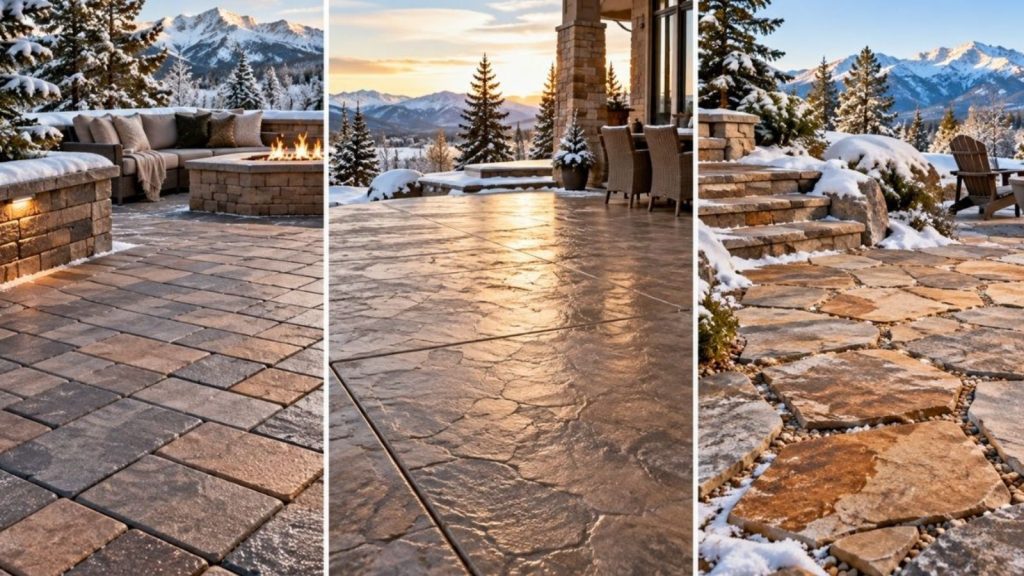
Colorado homeowners planning a new patio need to consider more than its summer appearance. The surface must withstand freezing temperatures, snow, ice, and seasonal ground movement.
Pavers, stamped concrete, and natural flagstone each have advantages. For Colorado winter hardscaping, concrete pavers generally offer the best balance of durability and repairability, while the other materials suit different design and maintenance priorities.
How Colorado Winters Affect Hardscape Materials
Successful Colorado winter hardscaping starts with understanding how moisture and ground movement affect outdoor surfaces. Water can collect beneath a patio or enter small openings. When it freezes, expansion can contribute to cracking, shifting, and surface damage.
Clay-heavy soils in parts of Northern Colorado can also retain moisture and contribute to seasonal movement.
Common signs of winter-related hardscape problems include:
-
Uneven surfaces: Sections rise or settle as the underlying soil moves.
-
Cracked areas: Temperature changes and moisture exposure contribute to deterioration.
-
Loose joints: Joint materials wash out, allowing individual units to move.
-
Water pooling: Poor grading leaves moisture beneath or around the patio.
Material selection matters, but proper installation and drainage matter just as much.
Concrete Pavers Balance Durability and Repairability
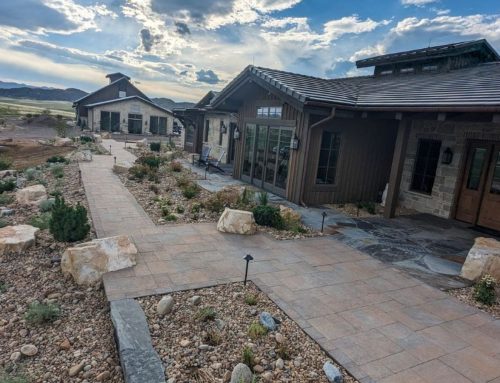
Concrete pavers are individual manufactured units arranged in a pattern. Their interlocking design allows some movement, unlike a continuous concrete slab.
If a section settles or shifts, you can lift individual pavers, correct the base, and reinstall them. This makes localized repairs easier than repairing a continuous surface.
Several factors influence winter performance:
-
Product quality: Choose pavers designed for outdoor freeze-thaw exposure.
-
Water absorption: Review the manufacturer’s moisture-resistance specifications.
-
Thickness: Select products suited to the intended use and expected loads.
-
Edge restraints: Ensure adequate support to prevent units from spreading.
Ask whether the selected pavers meet ASTM C936 requirements and whether the manufacturer provides freeze-thaw testing information under ASTM C1645.
Pavers still need a properly prepared base and effective drainage. Their main advantage is the ability to adjust or replace individual units when problems occur.
Stamped Concrete Requires Maintenance
Stamped concrete creates the appearance of stone, brick, or other decorative surfaces. Patterns and textures are pressed into freshly poured concrete to create a continuous patio.
Although its uniform appearance appeals to many homeowners, stamped concrete can crack as the ground moves or temperatures change. Repairs may also be noticeable when matching the original color and texture is difficult.
To improve performance, homeowners should consider:
-
Concrete quality: Use a mix designed for outdoor freeze-thaw exposure.
-
Air entrainment: Confirm that the mix includes suitable air entrainment for freezing conditions.
-
Curing: Allow the concrete to cure properly.
-
Control joints: Plan joints to help manage where cracking occurs.
-
Sealing: Use a compatible sealer when recommended.
Control joints do not guarantee a crack-free surface, and air entrainment alone cannot prevent all damage. Homeowners should also discuss appropriate snow-removal methods and deicing products with their contractor.
Stamped concrete suits homeowners who prefer a continuous decorative finish and accept periodic maintenance and potentially more visible repairs.
Natural Flagstone Requires Careful Selection
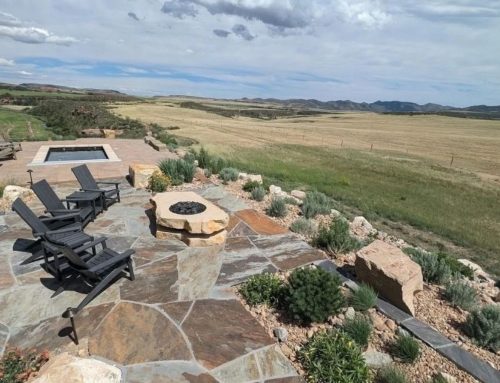
Natural flagstone provides distinctive textures, irregular shapes, and color variations. Its appearance works well with landscapes designed around native plants and organic outdoor features.
Winter performance depends on the specific stone. Sandstone, slate, and limestone vary in density, porosity, and moisture resistance.
Before selecting flagstone, consider:
-
Density and porosity: Highly absorbent stone may be more vulnerable to freeze-thaw damage.
-
Thickness: Suitable, consistent thickness helps create a stable walking surface.
-
Climate suitability: Confirm that the stone can withstand repeated freezing and thawing.
Installation method also affects maintenance:
Consideration |
Dry-laid |
Mortared |
|---|---|---|
Installation |
Stones placed over a prepared base |
Stones secured with mortar |
Movement |
Allows some adjustment |
More rigid |
Repairs |
Individual stones can be reset |
Mortar joints may need repair |
Dry-laid flagstone is generally easier to adjust when sections settle. Mortared installations are more rigid, but joints may crack as the ground moves.
Flagstone is a good option for homeowners who value natural character and are willing to invest in suitable stone and careful installation.
Comparing Hardscape Materials for Colorado Winters
Each material has different strengths. Homeowners should compare winter performance, repair options, and maintenance requirements.
Consideration |
Concrete Pavers |
Stamped Concrete |
Natural Flagstone |
|---|---|---|---|
Freeze-Thaw Resistance |
Durable when manufactured for outdoor exposure |
Depends on concrete mix, curing, and installation |
Varies by stone density and water absorption |
Ground Movement |
Individual units can accommodate minor shifts |
Ground movement can cause visible cracks |
Depends on whether stones are dry-laid or mortared |
Repair Options |
Individual pavers can be lifted and replaced |
Repairs may leave noticeable color or texture differences |
Individual stones can often be reset |
Water Management |
Requires a stable base and proper grading |
Requires effective surface drainage |
Dry-laid joints may allow water to pass through |
Ongoing Maintenance |
Occasional leveling and joint sand replacement |
Periodic sealing and crack repairs |
Joint maintenance and occasional resetting |
Concrete pavers offer a strong combination of repairability and winter performance when properly selected and installed. Flagstone provides a natural alternative, while stamped concrete suits homeowners who prefer a seamless decorative finish.
Base Preparation and Drainage Determine Long-Term Performance
For lasting Colorado winter hardscaping, proper base preparation and drainage are as important as the surface material. Northern Colorado soil conditions and property grading deserve particular attention.
Before installation, a contractor should evaluate:
-
Soil conditions: Determine whether excavation or stabilization is needed.
-
Base preparation: Select suitable aggregate and compact it in layers.
-
Drainage: Direct water away from the house and prevent pooling.
-
Finished elevations: Account for nearby doorways, walkways, and landscaping.
-
Edge support: Provide adequate support along installation boundaries.
Homeowners should ask where rainwater and melting snow will go and how the installation can be repaired if the underlying soil shifts. Addressing these issues during construction is generally less disruptive than correcting them later.
SolMauna provides custom patio designs and hardscaping for homeowners in Fort Collins and surrounding areas. Its patio paver and flagstone services offer tailored paving solutions that complement the property’s landscape and outdoor living goals.
Concrete pavers are generally the most practical choice when repair flexibility is a priority. Natural flagstone offers an attractive alternative when the stone suits the climate, while stamped concrete works for homeowners who prefer a continuous decorative surface.
The best Colorado winter hardscaping solution combines a suitable product, proper installation, and effective water management to keep an outdoor space functional through changing seasons.
Frequently Asked Questions
Are concrete pavers slippery when covered with snow or ice?
They can become slippery, particularly when smooth or covered with ice. Textured pavers can improve traction, but no hardscape material is completely slip-proof. Regular snow removal remains important.
Should outdoor pavers be sealed before winter?
Not necessarily. Some concrete pavers are designed to perform without sealers. If sealing is recommended, use a compatible product and follow the manufacturer’s instructions.
Can deicing salt damage concrete pavers?
Some deicing products can contribute to surface deterioration, especially when used improperly. Follow the paver manufacturer’s recommendations and ask about suitable alternatives.
Which hardscape material is easiest to repair after winter damage?
Concrete pavers are generally easiest to repair because individual units can be lifted, replaced, or reset. Dry-laid flagstone also allows individual stones to be adjusted, while stamped concrete repairs can be more noticeable.
When is the best time to install a new patio in Colorado?
Spring through early fall generally offers suitable installation opportunities, provided the ground is not frozen and weather conditions allow proper construction. Scheduling ahead gives contractors time to complete excavation, grading, and base preparation.
SOLMAUNA Creations & Landscaping Designs in Colorado
Our team of landscape designers brings a unique combination of landscape architecture education paired with extensive knowledge of plants to the table. Contact us today.
SOLMAUNA Creations & Landscaping Designs in Colorado
Our team of landscape designers brings a unique combination of landscape architecture education paired with extensive knowledge of plants to the table. Contact us today.
Pavers vs. Stamped Concrete vs. Natural Flagstone: Which Hardscape Survives Colorado Winters Best?
Colorado homeowners planning a new patio need to consider more than its summer appearance. The surface must withstand freezing temperatures, snow, ice, and seasonal ground movement.
Pavers, stamped concrete, and natural flagstone each have advantages. For Colorado winter hardscaping, concrete pavers generally offer the best balance of durability and repairability, while the other materials suit different design and maintenance priorities.
How Colorado Winters Affect Hardscape Materials
Successful Colorado winter hardscaping starts with understanding how moisture and ground movement affect outdoor surfaces. Water can collect beneath a patio or enter small openings. When it freezes, expansion can contribute to cracking, shifting, and surface damage.
Clay-heavy soils in parts of Northern Colorado can also retain moisture and contribute to seasonal movement.
Common signs of winter-related hardscape problems include:
-
Uneven surfaces: Sections rise or settle as the underlying soil moves.
-
Cracked areas: Temperature changes and moisture exposure contribute to deterioration.
-
Loose joints: Joint materials wash out, allowing individual units to move.
-
Water pooling: Poor grading leaves moisture beneath or around the patio.
Material selection matters, but proper installation and drainage matter just as much.
Concrete Pavers Balance Durability and Repairability
Concrete pavers are individual manufactured units arranged in a pattern. Their interlocking design allows some movement, unlike a continuous concrete slab.
If a section settles or shifts, you can lift individual pavers, correct the base, and reinstall them. This makes localized repairs easier than repairing a continuous surface.
Several factors influence winter performance:
-
Product quality: Choose pavers designed for outdoor freeze-thaw exposure.
-
Water absorption: Review the manufacturer’s moisture-resistance specifications.
-
Thickness: Select products suited to the intended use and expected loads.
-
Edge restraints: Ensure adequate support to prevent units from spreading.
Ask whether the selected pavers meet ASTM C936 requirements and whether the manufacturer provides freeze-thaw testing information under ASTM C1645.
Pavers still need a properly prepared base and effective drainage. Their main advantage is the ability to adjust or replace individual units when problems occur.
Stamped Concrete Requires Maintenance
Stamped concrete creates the appearance of stone, brick, or other decorative surfaces. Patterns and textures are pressed into freshly poured concrete to create a continuous patio.
Although its uniform appearance appeals to many homeowners, stamped concrete can crack as the ground moves or temperatures change. Repairs may also be noticeable when matching the original color and texture is difficult.
To improve performance, homeowners should consider:
-
Concrete quality: Use a mix designed for outdoor freeze-thaw exposure.
-
Air entrainment: Confirm that the mix includes suitable air entrainment for freezing conditions.
-
Curing: Allow the concrete to cure properly.
-
Control joints: Plan joints to help manage where cracking occurs.
-
Sealing: Use a compatible sealer when recommended.
Control joints do not guarantee a crack-free surface, and air entrainment alone cannot prevent all damage. Homeowners should also discuss appropriate snow-removal methods and deicing products with their contractor.
Stamped concrete suits homeowners who prefer a continuous decorative finish and accept periodic maintenance and potentially more visible repairs.
Natural Flagstone Requires Careful Selection
Natural flagstone provides distinctive textures, irregular shapes, and color variations. Its appearance works well with landscapes designed around native plants and organic outdoor features.
Winter performance depends on the specific stone. Sandstone, slate, and limestone vary in density, porosity, and moisture resistance.
Before selecting flagstone, consider:
-
Density and porosity: Highly absorbent stone may be more vulnerable to freeze-thaw damage.
-
Thickness: Suitable, consistent thickness helps create a stable walking surface.
-
Climate suitability: Confirm that the stone can withstand repeated freezing and thawing.
Installation method also affects maintenance:
Consideration |
Dry-laid |
Mortared |
|---|---|---|
Installation |
Stones placed over a prepared base |
Stones secured with mortar |
Movement |
Allows some adjustment |
More rigid |
Repairs |
Individual stones can be reset |
Mortar joints may need repair |
Dry-laid flagstone is generally easier to adjust when sections settle. Mortared installations are more rigid, but joints may crack as the ground moves.
Flagstone is a good option for homeowners who value natural character and are willing to invest in suitable stone and careful installation.
Comparing Hardscape Materials for Colorado Winters
Each material has different strengths. Homeowners should compare winter performance, repair options, and maintenance requirements.
Consideration |
Concrete Pavers |
Stamped Concrete |
Natural Flagstone |
|---|---|---|---|
Freeze-Thaw Resistance |
Durable when manufactured for outdoor exposure |
Depends on concrete mix, curing, and installation |
Varies by stone density and water absorption |
Ground Movement |
Individual units can accommodate minor shifts |
Ground movement can cause visible cracks |
Depends on whether stones are dry-laid or mortared |
Repair Options |
Individual pavers can be lifted and replaced |
Repairs may leave noticeable color or texture differences |
Individual stones can often be reset |
Water Management |
Requires a stable base and proper grading |
Requires effective surface drainage |
Dry-laid joints may allow water to pass through |
Ongoing Maintenance |
Occasional leveling and joint sand replacement |
Periodic sealing and crack repairs |
Joint maintenance and occasional resetting |
Concrete pavers offer a strong combination of repairability and winter performance when properly selected and installed. Flagstone provides a natural alternative, while stamped concrete suits homeowners who prefer a seamless decorative finish.
Base Preparation and Drainage Determine Long-Term Performance
For lasting Colorado winter hardscaping, proper base preparation and drainage are as important as the surface material. Northern Colorado soil conditions and property grading deserve particular attention.
Before installation, a contractor should evaluate:
-
Soil conditions: Determine whether excavation or stabilization is needed.
-
Base preparation: Select suitable aggregate and compact it in layers.
-
Drainage: Direct water away from the house and prevent pooling.
-
Finished elevations: Account for nearby doorways, walkways, and landscaping.
-
Edge support: Provide adequate support along installation boundaries.